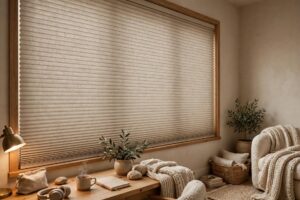
Faux wood blinds have come a long way from the cheap-looking plastic alternatives they used to be. Today’s options are built to handle real wear, look close to genuine wood, and hold up in environments where real wood wouldn’t. For homeowners in Friendswood dealing with humidity, frequent temperature changes, and rooms that get a lot of use, faux wood blinds are often a better fit than people expect.
What Faux Wood Blinds Are Actually Made Of
The name can be a little misleading. Faux wood blinds are typically made from PVC or a composite material that combines wood particles with a synthetic binding agent. The result is a slat that mimics the look and weight of real wood but doesn’t absorb moisture or warp when exposed to heat.
That matters in Friendswood. Summers here push humidity to uncomfortable levels, and real wood expands and contracts with those changes. Over time, that leads to warping, sticking, and slats that won’t lay flat. Faux wood handles the same conditions without those issues.
How They Compare to Real Wood Blinds
Real wood blinds have their place. They feel lighter when raised and have a more natural grain pattern. But they’re also more expensive, require more care, and are not ideal for kitchens, bathrooms, or any room where moisture is a factor.
Faux wood costs less upfront, requires almost no maintenance, and works across every room in the house. For homeowners who want the wood look without the upkeep, the choice is fairly straightforward.
Why Faux Wood Works Well in Friendswood Homes
Friendswood has a mix of older homes with traditional interior styles and newer construction that leans toward cleaner lines and neutral palettes. Faux wood blinds fit both. The slat profiles and finish options are wide enough that you can match them to painted woodwork, stained trim, or contemporary hardware without much effort.
They also hold up well against direct sun exposure. Windows in Friendswood get significant sun through most of the year, and faux wood handles UV exposure better than real wood. It won’t bleach out or develop surface cracks over time the way natural wood can.
Best Rooms for Faux Wood Blinds
Faux wood works in any room, but it’s especially practical in a few specific spaces. Kitchens are the obvious one, between cooking humidity and grease, you want a surface you can wipe clean easily. Bathrooms are another. The moisture from showers and baths makes real wood a poor choice, but faux wood holds up without any special treatment.
Living rooms and bedrooms also do well with faux wood, especially for homeowners who want a consistent look throughout the house without paying the premium for real wood in every room.
Light Control & Privacy
One of the main reasons people choose blinds over other window treatments is the level of control they offer. You can tilt the slats to let in diffused light while keeping the room private, raise them entirely for a clear view, or close them fully for complete coverage.
Faux wood slats are typically 2 inches wide, which gives a clean sightline when open and good coverage when closed. They don’t have the same range as roller shades for managing glare at specific angles, but for rooms where you want either fully open or fully closed, blinds give you more day-to-day control.
Cordless & Motorized Options
Safety and convenience have pushed the blind industry toward cordless and motorized designs in recent years. Cordless faux wood blinds use a simple lift mechanism that doesn’t leave hanging cords, which matters in homes with young children. Motorized options let you adjust multiple blinds at once from a remote or phone app, which is useful for rooms with several windows or hard-to-reach installations.
Both options are available in faux wood and don’t significantly change the appearance of the blind itself.
Getting the Right Fit
Blind installation looks simple but has a few details that matter. Inside-mount blinds sit inside the window frame and give a cleaner, more built-in look. Outside-mount blinds attach to the wall or trim above the window and can make a window appear larger. The right choice depends on the window depth, the trim style, and personal preference.
Accurate measurement is the part most homeowners underestimate. A blind that’s even a quarter inch too wide won’t mount inside the frame properly. One that’s too narrow leaves gaps along the sides that let in light and reduce privacy. Getting the measurements right before ordering is the difference between a clean result and one that needs to be corrected later.
What to Expect During Installation
Once the blinds arrive, installation is straightforward for someone who knows what they’re doing. The brackets go in level, the headrail clicks into place, and the wand or lift cord gets attached. Each window should be tested for smooth operation before moving on. Slats that catch or a cord that binds up usually means something isn’t aligned correctly, and it’s easier to address during installation than after the fact.
Faux Wood Blinds Are a Practical Choice
They’re not the most high-end option on the market, and they’re not trying to be. Faux wood blinds are a durable, low-maintenance solution that looks good and handles everyday use without demanding much from the homeowner. In Friendswood, where the climate is hard on materials and practicality matters, that’s a real advantage. If you’re looking for a window covering that does its job well and holds up over time, faux wood blinds are a solid place to start.
We measure and install window treatments for homes in Friendswood, League City, Pearland, and Clear Lake. Book a free in-home estimate to see samples in your own windows before you decide.