Shopping for blinds gets overwhelming fast. You start out thinking you just need something to cover the windows, and then you run into material choices, slat sizes, mount types, opacity levels, and color options. The thing that trips most people up is trying to find one answer for the whole house. The truth is the right blinds for your bedroom are probably not the right blinds for your kitchen, and that’s fine. The better way to do it is room by room.
Once you start thinking about what each room actually needs, the choices get a lot clearer. Here’s how to work through it space by space.
Start With What Each Room Does
Every room has a job, and the blinds need to support that job. A bedroom is for sleeping. A kitchen is a workspace that deals with moisture and mess. A bathroom is all about privacy. Before you look at a single product, think about how you actually use the room and what the windows need to do for it.
There are four things to weigh in every room. Light control, which is how much sun you want to let in or block. Privacy, which is how exposed the room is and when you need it covered. Moisture and durability, which is about what the material has to put up with. And style, which is how the blinds should look in the space. Different rooms rank these differently, and that ranking points you to the right product.
Choosing Blinds for the Living Room
The living room is usually the most visible space in the house and gets a lot of daily use. You want blinds that look good and give you flexible light control.
Best Options
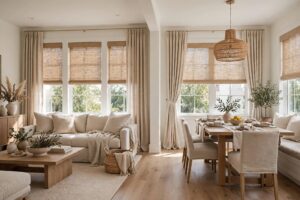
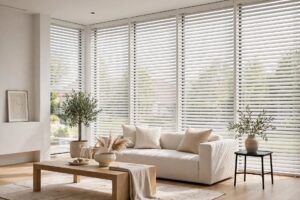
Wood blinds and faux wood blinds both work well here. They have a warm, classic look and the wider slats give you good control over light and privacy. A 2-inch or 2.5-inch slat looks proportional in most living rooms. If your living room has a more modern feel, roller shades or solar shades keep things clean and simple.
What to Think About
Living rooms often have larger windows, so the weight and operation of the blinds matter. If the windows are tall or hard to reach, consider motorized options. Many homeowners also layer drapery panels on the sides for a finished look.
Choosing Blinds for the Bedroom
Bedrooms are about sleep, so light control and privacy lead the way. You want the room to get dark when you need it dark.
Best Options
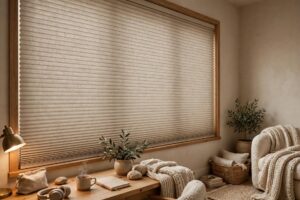
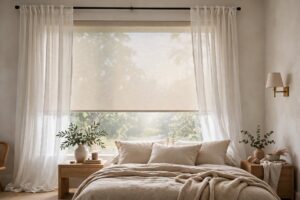
Blackout roller shades are a strong choice because they block almost all incoming light. Wood blinds or faux wood blinds paired with blackout drapery also work well. Some people go with cellular shades in a room-darkening fabric, which add insulation as a bonus.
What to Think About
Light leaks around the edges of the blinds can undercut even the best blackout fabric. An outside mount that covers the whole window opening helps reduce those gaps. Top-down bottom-up shades are also popular here because you can let light in from the top while keeping the lower half private.
Choosing Blinds for the Kitchen
Kitchens are tough on window coverings. Steam, grease, splashes, and constant handling all take a toll. The material has to hold up.
Best Options
Faux wood blinds are the go-to for kitchens. They look like real wood but handle moisture and clean up easily with a damp cloth. Aluminum blinds and vinyl blinds are also practical here. They wipe down fast and don’t mind humidity at all.
What to Avoid
Real wood is a poor choice for kitchens. The moisture and heat can warp the slats and damage the finish over time. Fabric shades can also absorb cooking odors and grease, so they’re not ideal near the stove.
Choosing Blinds for the Bathroom
Bathrooms have the highest humidity in the house, and privacy is non-negotiable. The material choice is the big decision here.
Best Options
Faux wood blinds, vinyl blinds, aluminum blinds, and composite shutters all handle bathroom conditions well. They resist moisture, won’t warp, and clean up easily. For privacy, room-darkening or blackout options give you full coverage day and night.
What to Avoid
Real wood blinds and untreated fabric shades don’t belong in a full bathroom. The humidity will damage them. Stick with materials built to take moisture.
Choosing Blinds for the Home Office
Home offices have a specific problem, which is glare on screens. The blinds need to manage light without making the room feel like a cave.
Best Options
Solar shades with a low openness factor, around 3 to 5 percent, cut screen glare while keeping the room bright and connected to the outside. Faux wood blinds also work if you want adjustable slats you can angle away from your monitor. If you take video calls, a light filtering fabric adds a clean background and some privacy. Think about where the sun hits during your working hours and where your screen sits in relation to the window.
Choosing Blinds for Kids’ Rooms
Kids’ rooms need to be safe first, and they also benefit from good light control for naps and early bedtimes.
Best Options
Cordless blinds and shades are the safest choice for any room a child uses. Cordless faux wood blinds, cordless cellular shades, or motorized options remove the cord hazard entirely. Room-darkening fabrics help with naps and summer bedtimes when the sun is still up. Durability matters here too, since faux wood and aluminum hold up better to bumps and rough handling than more delicate materials.
Picking Materials at a Glance
Here’s a quick way to think about the main materials.
Real Wood
Warm and classic. Great for living rooms, bedrooms, dining rooms, and offices. Keep it out of kitchens and bathrooms because of moisture.
Faux Wood
The all-purpose workhorse. Looks like wood, handles moisture and heat, and works in almost any room. The most versatile choice for most homes.
Aluminum
Lightweight and affordable. Good for kitchens, bathrooms, kids’ rooms, and anywhere function matters more than a high-end look.
Vinyl & Fabric Shades
Vinyl is moisture-proof and budget-friendly, a solid pick for bathrooms and laundry rooms. Fabric shades like roller, cellular, and roman shades add a softer, more stylish feel and suit living rooms, bedrooms, and offices, though they’re less ideal for kitchens and bathrooms.
Keep Some Consistency
Choosing room by room doesn’t mean every room should look totally different. A good approach is to pick a consistent color family or a couple of repeating materials so the house feels connected. For example, faux wood in a single finish across most of the house, with roller shades in coordinating tones where you need them.
Don’t Forget Mount Type
After material, the mount is the next decision. An inside mount sits within the window frame for a clean, built-in look but needs enough frame depth. An outside mount covers the whole opening and is better for blocking light. For bedrooms and bathrooms where privacy and darkness matter most, an outside mount usually wins.
Get the Measurements Right
No matter which blinds you choose for which room, the measurements have to be accurate. Windows are often slightly out of square, and a blind that’s even a little off will show gaps or rub against the frame. Measuring carefully, or having someone measure for you, is what makes the difference between blinds that look custom and blinds that look like an afterthought.
Final Thoughts
The easiest way to choose blinds for your home is to stop looking for one answer and start going room by room. Figure out what each space needs in terms of light, privacy, moisture, and style, then match the material and product to that. Keep a little consistency across the house so it all feels connected, pick the right mount for each room, and measure carefully. Do that and every room ends up with blinds that fit how you live in it.
We measure and install window treatments for homes in Friendswood, League City, Pearland, and Clear Lake. Book a free in-home estimate to see samples in your own windows before you decide.