Working from home put a lot of attention on a room that used to be an afterthought. The home office went from a spare desk in the corner to a place you spend hours a day. And the window in that room has more say over how the space works than most people expect. Get the light right and the room is easy to work in. Get it wrong and you fight glare on your screen, squint through video calls, and reach for the lamp at the wrong times. The window covering is what makes the difference.
Here is how to pick window coverings for a home office so the light works for you instead of against you.
What a Home Office Window Needs to Do
A home office window has a few jobs at once. It has to manage glare on your screen, control how much daylight comes in, give you privacy for calls, and keep the room comfortable through the day. No single feature covers all of that, so the right covering balances them.
The biggest issue is glare. A screen near a sunny window washes out, and you end up tilting your monitor or closing the covering all the way, which leaves you working in the dark. The goal is a covering that cuts the glare while keeping the room bright enough to work in without flipping on every light.
Glare on Your Screen
Direct sun hitting a monitor reflects back at you and makes the screen hard to read. It strains your eyes and slows you down. A covering that filters the light before it reaches the screen fixes this without leaving you in a dim room. This is the first thing to solve in a home office.
Light Without the Lamp
You want daylight in a workspace. Natural light feels better to work in than lamps alone and keeps the room from feeling like a cave. The trick is getting that daylight in without the glare. A covering that spreads the light evenly gives you both.
Solar Shades for Screen Work
Solar shades are a strong pick for a home office. The woven screen fabric cuts glare and heat while still letting you see out. You keep the daylight and the view, and the harsh sun that bounces off your screen gets knocked down to a level you can work in.
The openness factor lets you set how much sun you block. For a desk that faces bad glare, a tighter weave around 3 to 5 percent cuts more of it. For a room where the view matters and glare is mild, a more open weave keeps things clearer. Darker fabrics give a better view out and cut glare well, which is why a lot of home offices go with a darker solar shade behind the desk.
Light Filtering Shades for an Even Glow
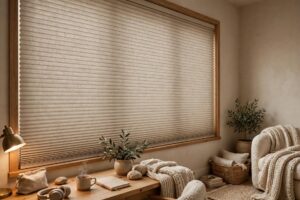
If you want the room soft and bright rather than screen focused, light filtering shades spread daylight across the space without the hard edge. The fabric scatters the sun so it comes in even, which keeps the room lit without the glare that bounces off a monitor.
These work well in an office where the desk does not sit right in front of the window, or where you want the whole room to feel bright and open. They keep the daylight while taking the harshness out of it, so the space stays pleasant to spend hours in.
Blackout Options for Video Calls & Presentations
Some home office work calls for control over the light in the other direction. If you record video, run presentations, or take a lot of calls where lighting matters, being able to darken the room helps. Blackout shades let you shut the daylight out so you can control the lighting with lamps or a setup of your own.
A common move is to pair a light filtering or solar shade for everyday work with a blackout layer for the times you need the room dark. Most of the day you keep the soft light. When you need to control the lighting for a call or a recording, you drop the blackout layer. That layered setup covers both modes on one window.
Shutters & Blinds for a Professional Look
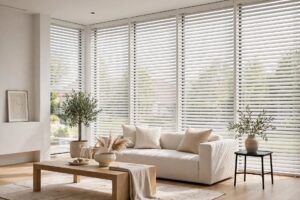
If your home office shows up on camera, the look of the window matters too. Plantation shutters give a clean, built in appearance that reads as polished behind you on a call. The louvers tilt to manage light and privacy, so you control the sun while keeping a sharp backdrop.
Faux wood blinds offer a similar tilt control with a more classic look. You angle the slats to cut the sun off your screen or close them for privacy during a call. Both shutters and blinds let you fine tune the light through the day, which suits a room where the sun moves across the window from morning to afternoon.
Privacy for Calls & Focus
A home office often needs privacy, both so people outside cannot see in and so you can focus without the outside pulling your eye. Solar shades give daytime privacy while keeping the view. Light filtering shades soften the room and obscure the inside during the day. Shutters and blinds close down for full privacy when you want the room shut off for a call or deep work.
For an office on a ground floor or facing a street or neighbor, privacy carries more weight. A covering you can close fully, or a layered setup, gives you the option to shut the room off when you need to and open it back up when you want the light and view.
Comfort Through the Workday
A home office you sit in for hours has to stay comfortable. A window in direct sun heats the room up and makes the afternoon rough. Coverings that block some of that heat keep the room from getting warm while the sun is on the glass. Solar shades cut heat along with glare. Cellular shades, with their honeycomb pockets, trap air and help hold the temperature steady, which keeps the room comfortable without running the air conditioner hard.
A comfortable room is an easier room to work in. The covering that manages heat does as much for your focus over a long day as the one that manages glare.
Getting the Fit & Operation Right
A home office covering has to fit the window and operate easily, since you adjust it through the day as the sun moves. Cordless lifts keep the operation simple and clean. Motorized options let you move the covering without leaving your chair, which is handy when the sun shifts mid task or mid call. For a tall or hard to reach window, a motor saves you getting up every time.
The fit matters too. A covering measured for the exact window sits clean and operates smoothly. An inside mount keeps a tidy look within the frame. An outside mount covers more and blocks more light at the edges, which helps if glare control is the main goal. A proper measure and install keeps the covering working right for years of daily use.
Bringing It Together
The best home office window coverings handle glare first, since a washed out screen is the issue most people deal with. Solar shades cut the glare and heat while keeping the view, light filtering shades give an even glow for a bright room, and blackout layers let you control the light for calls and recording. Shutters and blinds add a polished look and tilt control for the windows that show up on camera.
Add privacy for calls and focus, coverings that keep the room comfortable through the afternoon, and an easy lift you can adjust as the sun moves, and the office works the way you need it to. Sort out the window, and the rest of working from home gets a lot more pleasant.
We measure and install window treatments for homes in Friendswood, League City, Pearland, and Clear Lake. Book a free in-home estimate to see samples in your own windows before you decide.