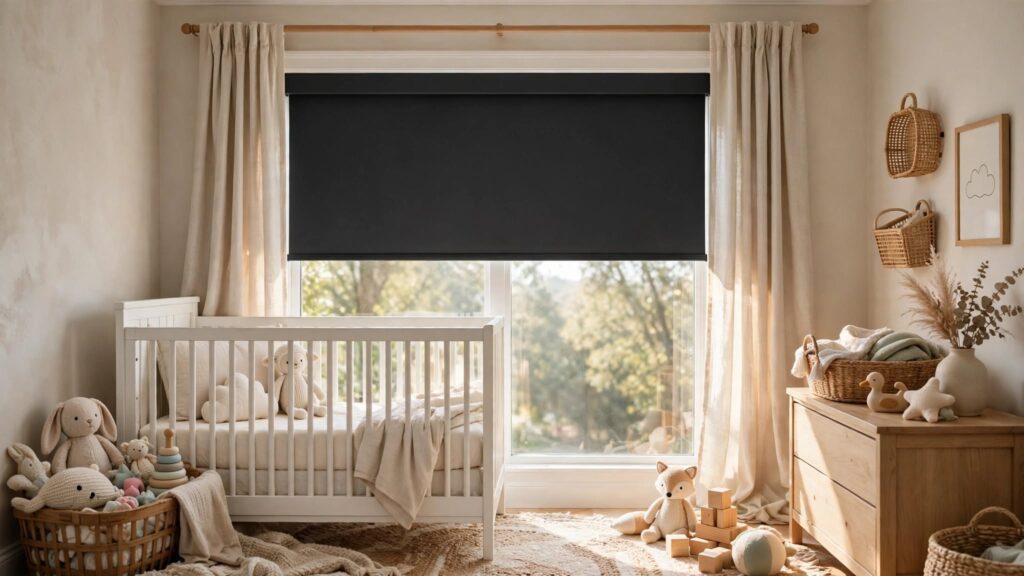
A nursery is a room built around a baby’s safety and sleep, and the window covering plays a bigger part in both than most new parents expect. The covering has to be safe, with no cords that pose a hazard near a crib. It has to darken the room for naps and nighttime sleep. And it has to hold up to the daily use of a busy nursery while staying easy to keep clean. Getting the window covering right is one of the quieter but more important choices in setting up a nursery.
Here is how to choose a safe and practical window covering for a nursery.
Safety Comes First
In a nursery, safety is the top concern, and the window covering is a real part of that. Corded blinds have been tied to accidents in homes with young children, since a dangling cord can wrap around a small child’s neck. A crib or changing table near a window puts a cord right at a baby’s level, which is a danger no parent wants in the room. So the first rule for a nursery covering is no cords.
Cordless and motorized coverings remove that hazard entirely, since there is no cord for a child to reach. This is the single most important thing about a nursery window covering, more than the look or even the darkness. A cordless covering lifts and lowers with a touch or a remote, with nothing dangling near the crib. For a nursery, going cordless or motorized is the foundation of a safe window, which is why it comes first in the choice. Everything else builds on that safe base.
Darkness for Naps & Sleep
A dark room helps a baby sleep, which makes blackout coverings a strong choice for a nursery. Babies nap during the day, and a room that stays dark helps them settle and stay asleep when the sun is up. At night, a dark room supports longer stretches of sleep. Blackout coverings block the light for the darkness a baby’s sleep needs, which helps the whole household rest better.
For a nursery, a blackout roller shade or a blackout cellular shade darkens the room for naps and nighttime. Getting the room truly dark takes handling the light around the edges too, since light leaks around the sides of a covering. An outside mount that covers the whole window frame, or side channels that close off the gaps, takes the room from mostly dark to truly dark. For a nursery built around a baby’s sleep, that darkness makes a real difference, which is why blackout coverings paired with a good fit matter so much.
Flexible Light for Daytime
While darkness matters for sleep, a nursery also needs some light during the day for playtime, feeding, and changing. So a covering that gives both darkness and daytime light suits a nursery well. Layering a blackout covering with a light filtering one lets you darken the room for naps and let soft light in when the baby is awake.
A common setup pairs a light filtering shade for daytime with a blackout shade for sleep. During the day, you use the light filtering shade for soft, gentle light, and for naps and nighttime, you drop the blackout layer for full darkness. This gives a nursery the flexibility to handle both the awake hours and the sleep hours on the same window. For a room used around the clock, that range matters, since a baby’s day moves between play and sleep. The layered setup covers both without you having to choose one over the other.
Practical & Easy to Clean
A nursery sees a lot of daily use, and the covering should hold up and stay easy to clean. Babies are messy, and the room gets busy, so a covering that wipes clean and handles daily wear suits a nursery. Faux wood blinds, roller shades, and cellular shades all clean up easily and hold up to the use a nursery brings, which keeps the room tidy without much effort.
Moisture resistance can matter too, since a nursery deals with spills and the occasional mess. Faux wood and roller shades with the right fabric wipe clean of the marks that come with a baby. A covering that is hard to clean or that holds stains becomes a chore in a busy nursery, so the easy-clean options are the practical choice. For a nursery, a covering that handles the daily mess and wipes clean keeps the room looking right while you focus on the baby rather than on fussing over the window.
Quiet Operation Helps
How a covering operates matters in a nursery, since a covering that rattles or clatters can wake a sleeping baby. Cordless and motorized coverings run quietly, which suits a room where you adjust the covering around naps. With a motor, you can lower the shade without reaching over the crib or making noise, which lets you darken the room without disturbing the baby.
Motorized coverings can also be set on a schedule, so the nursery darkens for naps at the same time each day and brightens gently in the morning. This supports a sleep routine without you having to handle the covering each time. For a nursery, quiet operation and the option of a schedule make the daily rhythm of naps and sleep easier to keep. The covering works in the background, darkening and brightening the room on cue, which helps both the baby and the parents through the day.
Getting the Fit Right
A nursery covering works best when it fits the window cleanly, especially for the darkness a baby’s sleep needs. Gaps around the edges let light leak in, which undoes a blackout covering’s job and can cut a nap short. A covering fit to the exact window, mounted to cover the edges, keeps the room as dark as possible. An outside mount or side channels close off the gaps that let light through.
A proper measure and install sets the covering up to darken the room fully and operate smoothly and quietly. For a nursery, that careful fit is part of what makes the covering do its job, since a loose covering leaves light gaps that disturb sleep. Getting the fit right ties the whole thing together, giving the nursery a covering that is safe, dark when it needs to be, and easy to live with. That combination is what a nursery window covering should deliver.
Setting Up a Safe Nursery Window
Choosing a safe and practical nursery covering starts with safety, which means going cordless or motorized to remove the cord hazard near the crib. From there, blackout coverings darken the room for naps and sleep, and layering with a light filtering shade gives soft light for the awake hours. Easy-clean coverings handle the daily mess, and quiet operation lets you adjust the room without waking the baby.
Get the fit right so the room darkens fully and the covering runs smoothly, which ties the safety, the darkness, and the practicality together. When you choose the covering that fits a nursery’s needs, the window supports a baby’s safety and sleep while staying easy to live with.