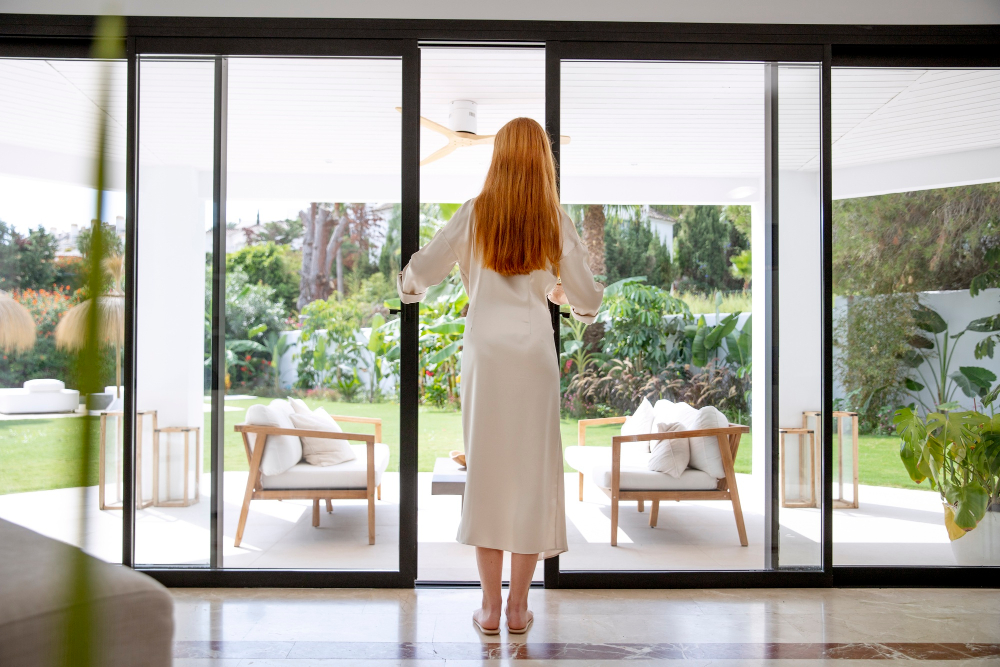
Sliding glass doors are great. They bring in light, connect your living space to the patio or backyard, and make a room feel open. They also create a window covering challenge that trips up a lot of homeowners. The door is wide, it’s tall, and part of it has to keep sliding open and closed. Standard blinds that work fine on a regular window often don’t work well here.
The good news is there are several blind and shade options built specifically for sliding glass doors. Once you know what’s out there and how each one handles the size and the movement, picking the right one gets a lot easier.
What Makes Sliding Doors Different
A sliding glass door is basically a very large window that doubles as a door. That combination is what makes covering it tricky.
First, there’s the size. Most sliding doors are six to eight feet wide and run close to the full height of the wall. That’s a lot of glass to cover, and a lot of light and heat coming through.
Second, there’s the movement. One panel of the door slides, which means the covering has to allow access to that panel without you having to fight your way past it every time you want to step outside.
Third, there’s the traffic. Sliding doors get used. People walk through them, kids run through them, pets scratch at them. The covering has to hold up to daily handling without getting damaged.
Top Options for Sliding Glass Doors
There are a handful of treatments that handle sliding doors well. Each one solves the access problem in its own way.
Vertical Blinds
Vertical blinds are the classic answer for sliding doors, and for good reason. The vanes hang from a track at the top and slide side to side, which matches how the door itself moves. You can rotate the vanes to control light and privacy, or slide them all to one side for a clear path through the door.
The old plastic vertical blinds had a dated look, but modern versions come in fabric, faux wood, and other materials that look much more current. They’re affordable, practical, and they just make sense for a door that slides.
Panel Track Blinds
Panel track blinds use wide fabric panels that slide along a track, stacking neatly to one side when open. They have a clean, modern look that works well in contemporary homes. The panels come in everything from sheer fabrics to room-darkening materials, so you can get exactly the light control you want.
Panel tracks are a favorite for larger sliding doors and for homeowners who want something that looks more current than traditional vertical blinds. The wide panels give the door a tailored, finished appearance.
Vertical Cellular Shades
Vertical cellular shades take the energy efficiency of honeycomb shades and put it on a track that slides. The cellular structure traps air and creates an insulating barrier, which matters a lot on a big slab of glass like a sliding door. They slide to the side for access and come in a range of opacities.
For anyone worried about heat gain or energy loss through their sliding door, this is one of the strongest options.
Roller & Solar Shades
Roller shades can work on sliding doors, though they’re usually mounted to cover the whole opening and rolled up when you want full access. Solar roller shades are especially good here because they cut heat and glare while letting you keep the view. The tradeoff is that you can’t slide them partway open the way you can with vertical blinds or panel tracks, so they work best on doors that don’t get opened constantly.
Plantation Shutters
Bypass and bifold plantation shutters are made specifically for sliding doors. Bypass shutters slide on a track, one panel passing behind the other. Bifold shutters fold accordion-style to one side. Either way, you get the built-in look and durability of shutters on a door that needs to move. Shutters cost more than the other options, but they last for decades and add a high-end look to the room.
Matching the Blind to How You Use the Door
The right choice depends a lot on how often you actually use the door.
Doors You Use Constantly
If the sliding door is your main path to the backyard and gets used dozens of times a day, you want something that slides easily out of the way. Vertical blinds, panel tracks, and vertical cellular shades are all good here because access is quick and easy.
Doors You Rarely Open
If the sliding door is more of a window that occasionally opens, you have more flexibility. Roller shades and solar shades become reasonable options because you’re not constantly working around them.
Doors in Bedrooms
A sliding door in a bedroom needs privacy and darkness. Room-darkening panel tracks, vertical cellular shades in a blackout fabric, or bypass shutters all do the job. Look for fabrics rated for room darkening so light doesn’t pour in around the edges in the morning.
Light Control & Privacy
Sliding doors let in a lot of light, and they’re often visible from the street or from a neighbor’s yard. Light control and privacy usually both matter.
Vertical blinds and panel tracks let you adjust the angle to get daytime privacy while still letting light in. For nighttime privacy, you want a heavier or room-darkening fabric, since lighter materials can show silhouettes when the interior lights are on.
Solar shades are great for cutting glare and heat during the day while keeping the view, but they don’t give much privacy at night. If the door faces a high-traffic area, factor that in.
Durability & Daily Use
Since sliding doors get a lot of traffic, the covering has to be durable. Look for sturdy tracks, quality vanes or panels, and mechanisms that operate smoothly under daily use. Cheaper products tend to develop problems at the points that move most, like the slides and the rotating mechanism. Cordless and wand-operated options are worth considering for safety, especially in homes with kids and pets.
Motorization
Motorized options exist for vertical blinds, panel tracks, and cellular shades. For a wide sliding door, motorization makes operation effortless and keeps things looking clean with no cords or wands. It also lets you put the covering on a schedule to manage heat and light automatically.
Getting the Measurements Right
Sliding doors leave no room for sloppy measurements. The covering needs to span the full opening and clear the door handle and frame so it can operate without catching. The mounting also has to account for how the door is recessed in the wall.
An inside mount sits within the door frame for a cleaner look, but it requires enough depth. An outside mount covers the whole opening and is often the more practical choice for sliding doors. Getting these details right is the difference between a covering that works smoothly and one that’s constantly catching or leaving gaps.
Summing It Up
The best blind for a sliding glass door is the one that matches how you use the door, controls light and privacy the way you need, and holds up to daily traffic. Vertical blinds and panel tracks are the most popular for good reason, vertical cellular shades win on energy efficiency, and bypass shutters bring a high-end look for those willing to invest. Think about how often the door opens, what the room needs, and how the covering will hold up over time. With the right choice and a proper installation, your sliding door can look good and work well at the same time.
We measure and install window treatments for homes in Friendswood, League City, Pearland, and Clear Lake. Book a free in-home estimate to see samples in your own windows before you decide.