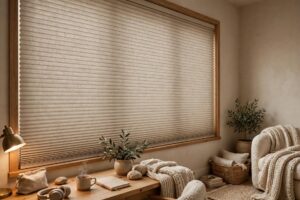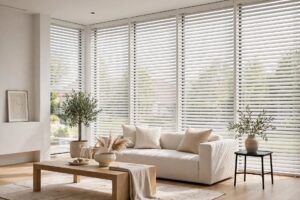
High ceilings give a room a sense of space, but they come with tall windows that are tricky to cover. The windows often climb well past arm’s reach, sometimes stacking a lower window under an upper one or topping out in an arch. Covering them takes a plan, since a standard covering meant for a normal window will look off and be a pain to reach. The right approach handles the height, keeps the room looking balanced, and stays easy to use.
Here is how to pick window coverings for high ceilings so the tall windows look right and work without a struggle.
Why Tall Windows Need a Different Approach
A window that runs from waist height up to a ten or twelve foot ceiling is a different problem than a normal window. Reaching the top to adjust a covering is hard without a ladder. The proportions are off if you cover a tall window like a short one. And the amount of glass means light, heat, and privacy all come into play on a bigger scale.
So the goal is a covering that reaches the full height, operates without you climbing anything, and suits the taller proportions of the room. Getting one of those right and missing the others leaves you with a window that looks good but is a chore, or one that is easy to use but looks wrong.
Reaching the Top
The biggest practical issue is reach. A covering you cannot operate from the floor gets left in one position, which defeats the point. This is why motorized options come up so often for tall windows. They handle the height problem directly.
Keeping the Proportions Right
A tall window wants a covering that respects its height. Coverings that hang long and clean suit the proportions, while ones that look stubby or crowded fight the room. The covering should feel like it belongs with the scale of the space.
Motorized Shades for the Height
Motorized shades are close to the standard answer for high windows. Since you cannot easily reach the top, a motor lets you raise and lower the covering with a remote, an app, or a schedule. No ladder, no long cords running down the wall, just a covering that moves on command.
This solves the reach problem cleanly and keeps tall windows usable. You can lower them against the afternoon sun and raise them for the view, all from the floor. For a room with several tall windows, setting them to move together on a schedule keeps the whole space managed without effort. Roller shades, cellular shades, and blinds all come motorized, so you can pick the style and still get the height handled.
Covering Stacked & Arched Windows
Tall windows often come in shapes that need extra thought. Many stack a working lower window under a fixed upper one, and some top out in an arch or a half circle.
Stacked Windows
For a window stacked in two parts, you can cover the lower working section with a shade or blind you use daily, while the upper section gets a fixed covering or is left open to bring in light. This keeps the part you use within reach while still handling the glass up high. Motorizing the lower section makes the daily use easy.
Arched Tops
An arch at the top of a window is a design feature worth keeping in view. You can leave the arch open and cover only the rectangular part below it, which keeps the shape on display while still handling light and privacy where you need it. If the arch faces strong sun, a fitted arch covering can cover it, though many people leave it open for the look.
Cellular Shades for Tall Glass
Tall windows mean a lot of glass, and glass is where a room loses and gains the most heat. Cellular shades help here. The honeycomb pockets trap air and slow the heat moving through all that glass, which keeps a room with tall windows more comfortable and takes load off heating and cooling.
For a room where the tall windows make it hot in summer or cold in winter, cellular shades address the energy side while covering the height. Paired with a motor, they handle the reach and the heat at once, which is a lot of the job done in one covering.
Keeping the Look Balanced
Tall windows carry visual weight, so the covering affects how balanced the room feels. Coverings that hang in clean vertical lines suit the height and draw the eye up in a good way. Drapery panels that run the full height add softness and play up the tall proportions. The idea is to work with the height rather than fight it.
Color plays a part too. A covering close to the wall color keeps tall windows from dominating the room, while a contrasting color makes them a feature. For a room where the windows are already a strong element, a quieter covering keeps things balanced.
Getting the Measurements Right
Tall windows are harder to measure and install than normal ones, and the stakes are higher since a mistake on a big window shows more. The height has to be measured accurately, the covering has to be sized to fit, and the install has to be solid so a large covering hangs straight and operates smoothly.
This is a spot where a professional measure and install earns its keep. Getting on a ladder to measure and mount a covering twelve feet up is not a simple task, and a covering that large has to be fit right to work well. A proper measure means the covering reaches the full height, hangs clean, and operates smoothly from the floor. For tall windows, that expert fit is a big part of getting a result that looks right and lasts.
Connecting the Dots
High ceilings and tall windows call for coverings that handle the height, suit the proportions, and stay easy to use. Motorized shades solve the reach problem, letting you move the covering from the floor. Stacked and arched windows need a plan that covers the working glass while keeping the shapes in view. Cellular shades address the heat that comes through all that glass, and a covering that hangs in clean lines keeps the room looking balanced.
Get the measurements and install correctly, since a large covering that is fit wrong shows more than a small one. Handle the height, keep the look balanced, and make the coverings easy to operate, and your tall windows will look right and work without a struggle.
We measure and install window treatments for homes in Friendswood, League City, Pearland, and Clear Lake. Book a free in-home estimate to see samples in your own windows before you decide.