A home office lives or dies by how it feels to work in, and the window has more to do with that than most people give it credit for. Get the light right and the room is easy to focus in. Get it wrong and you fight glare on your screen, squint through video calls, and reach for the lamp at the wrong times. Choosing the window covering for a home office comes down to handling the light, cutting glare, giving you privacy for calls, and keeping the room comfortable through a long day of work.
Here is how to choose a window covering for a home office that works with you rather than against you.
Start With How You Use the Room
Before picking a covering, think about how you actually use the office. Where does the desk sit in relation to the window? Do you spend the day on a screen, on video calls, or moving between tasks? Does the window face the morning or afternoon sun? The answers point you toward the covering that fits, since a desk facing a sunny window has different needs than one tucked in a shaded corner.
The biggest issue for most home offices is glare. A screen near a sunny window washes out, which strains your eyes and slows you down. So the first job of a home office covering is usually cutting glare while keeping the room bright enough to work in. From there, you add privacy for calls and comfort for the long hours. Starting with how you use the room keeps the choice focused on what the space actually needs rather than on looks alone.
Solar Shades for Screen Work
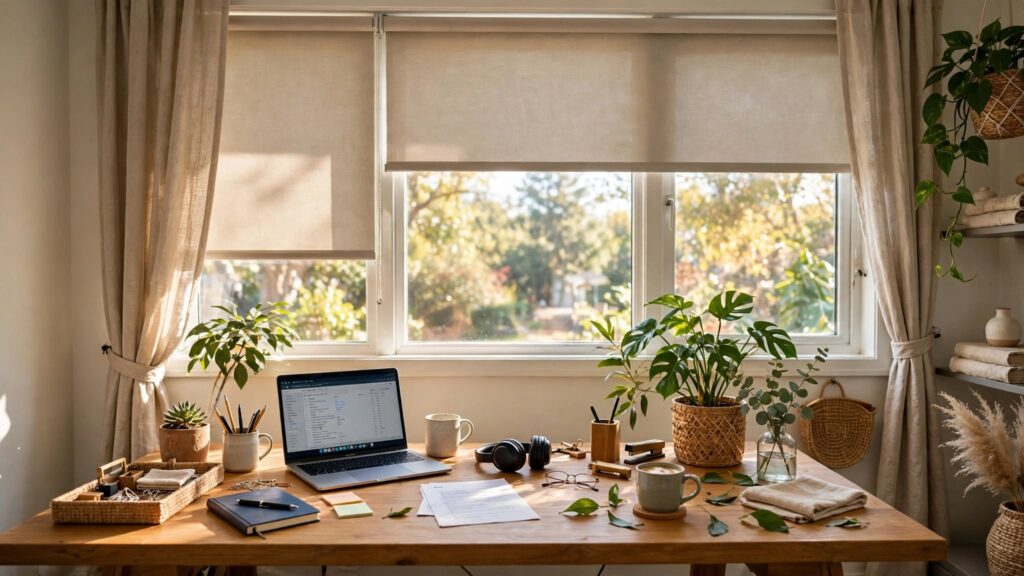
Solar shades are a strong pick for a home office because they cut glare and heat while keeping the view. The woven screen fabric knocks down the harsh sun that bounces off your screen, but you can still see out and the room stays bright. You get the daylight without the glare, which is the balance most home offices are after.
The openness of the weave lets you set how much sun you block. For a desk facing bad glare, a tighter weave cuts more of it, while a more open weave keeps more of the view. Darker fabrics give a clearer view out and cut glare well, which is why a lot of home offices go with a darker solar shade behind the desk. For a home office where glare on the screen is the main problem, a solar shade handles it while keeping the room open and lit, which suits a space you spend hours in.
Light Filtering Shades for an Even Glow
If you want the room soft and bright rather than focused on a screen, light filtering shades spread daylight across the space without the hard edge. The fabric scatters the sun so it comes in even, which keeps the room lit without the glare that bounces off a monitor. This suits an office where the desk does not sit right in front of the window.
Light filtering shades keep a home office feeling bright and open, which makes the space pleasant to work in through the day. They soften the sun and cut the harshness while keeping the daylight, so the room stays lit without turning on every lamp. For a home office where you want a warm, even light rather than a dark, screen-focused setup, light filtering shades fit the need. They keep the room bright and comfortable, which helps you stay focused over a long workday.
Blackout Options for Calls & Recording
Some home office work calls for control over the light in the other direction. If you record video, run presentations, or take a lot of calls where lighting matters, being able to darken the room helps. Blackout shades let you shut the daylight out so you can control the lighting with lamps or a setup of your own.
A common move is to pair a solar or light filtering shade for everyday work with a blackout layer for the times you need the room dark. Most of the day you keep the soft light, and when you need to control the lighting for a call or a recording, you drop the blackout layer. This layered setup covers both modes on one window, which suits a home office used for a mix of regular work and video. For an office where lighting control matters some of the time, the blackout layer gives you that option without giving up the daytime light.
Privacy & a Professional Look
A home office often needs privacy, both so people outside cannot see in and so you can focus. It also needs to look right if it shows up on camera. Solar shades give daytime privacy while keeping the view, and shutters or blinds close down for full privacy during a call or deep work. For a window facing a street or a neighbor, a covering you can close fully gives you the privacy you need.
For an office that appears on video calls, the look of the covering matters too. Plantation shutters give a clean, built-in look that reads as polished behind you on a call, and the louvers tilt to control the light. Faux wood blinds offer a similar tilt control with a classic look. Either one gives a home office a sharp backdrop while letting you fine-tune the light through the day. For a home office where appearance and privacy both matter, these coverings handle both along with the light.
Keeping the Room Comfortable
A home office you sit in for hours has to stay comfortable, and a window in direct sun heats the room up. Coverings that block some of that heat keep the room from getting warm while the sun is on the glass. Solar shades cut heat along with glare, and cellular shades trap air to hold the temperature steady, which keeps the room comfortable without running the air conditioner hard.
A comfortable room is an easier room to work in, so the covering that manages heat does as much for your focus over a long day as the one that manages glare. Getting the fit right matters too, since a covering measured for the exact window operates smoothly and blocks the light and heat evenly. A proper measure and install keeps the covering working the way it should, which is part of making the office comfortable to work in day after day.
Setting Up Your Home Office Window
Choosing a window covering for a home office starts with how you use the room and the glare you need to handle. Solar shades cut glare and heat while keeping the view, light filtering shades give an even glow for a bright room, and a blackout layer lets you control the light for calls and recording. Shutters and blinds add a polished look and tilt control for the windows that show up on camera, along with the privacy a workspace needs.
Keep the room comfortable through the day with coverings that manage heat, and get the fit right so everything works smoothly. When you choose the covering that fits how you work, the home office window stops being the reason you squint at your screen or reach for the lamp.