Choosing the right window coverings for your home doesn’t have to be overwhelming. Whether you’re looking for blinds, shades, or shutters, this comprehensive guide walks you through every decision step by step.
At Gulf Coast Blind and Shutter, we’ve helped thousands of Houston-area homeowners select and install the perfect window treatments for their unique needs. This guide combines our years of experience with practical advice you can use right away.
About Gulf Coast Blind and Shutter We’re a locally-owned window covering company serving the Houston area. We specialize in custom blinds, shades, and shutters designed to handle the unique demands of Houston’s climate. Our commitment to quality products, expert installation, and outstanding customer service has made us a trusted name in the community. Learn more about us and see why Houston homeowners choose Gulf Coast Blind and Shutter for their window covering needs.
Understanding Types of Window Coverings
Before you start choosing window coverings, it helps to understand what’s available. Here’s a quick overview of the main categories:Blinds
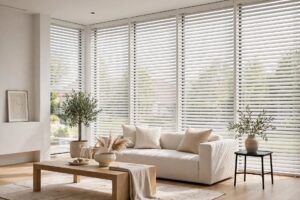
Blinds feature horizontal or vertical slats that tilt to control light and privacy. Common materials include:- Wood blinds — Natural wood with warm tones; best for low-humidity rooms
- Faux wood blinds — Moisture-resistant composite that looks like real wood
- Aluminum blinds — Budget-friendly metal; prone to denting
- Vinyl blinds — Lowest cost option; less durable
Shades
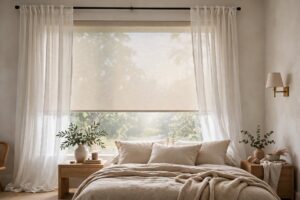
Shades are made from fabric or woven materials that raise and lower as a single piece:- Roller shades — Simple, modern design with fabric that rolls around a tube
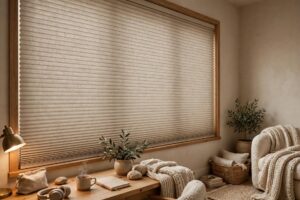
- Cellular (honeycomb) shades — Honeycomb structure traps air for excellent insulation
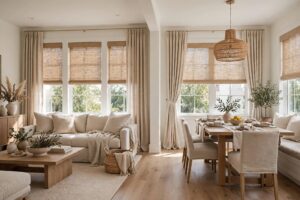
- Roman shades — Fabric folds into elegant horizontal pleats when raised
- Solar shades — Mesh fabric that blocks UV rays while maintaining views
Shutters
Plantation shutters are solid panels with adjustable louvers that mount inside or outside the window frame:- Wood shutters — Premium real wood; susceptible to warping in humid climates
- Composite shutters — Engineered material that resists moisture, warping, and fading
Curtains & Drapes
Fabric panels hung from a rod above the window. While we specialize in hard window treatments, curtains can complement blinds or shutters for added softness and light blocking. Can you use curtains with plantation shutters? Yes! Many homeowners pair shutters with curtains for enhanced light control and decorative appeal. Read our guide on pairing plantation shutters with curtains for design ideas.Valances & Cornices
Decorative top treatments that add finishing touches to other window coverings. Now that you understand the basic types, let’s walk through how to choose the right option for your home.Step 1: Identify What Each Room Needs
Start by walking through your home and noting what you need from each window. Every room has different requirements, and taking time to identify those needs upfront prevents costly mistakes later.Questions to Ask for Every Room
- Do you need to block light completely, filter it, or just reduce glare?
- How much privacy do you need, and at what times of day?
- Does the room get direct sun that creates heat or causes fading?
- Is there moisture from showers, cooking, or laundry?
- Are the windows easy to reach, or would you need a ladder to operate the treatments?
- Do you need child-safe, cordless options?
- What’s your priority: function, appearance, or both equally?
Room-by-Room Breakdown
Bedrooms
Bedrooms often need light-blocking capability for quality sleep. If you work night shifts or have young children who nap during the day, blackout capability matters even more. Consider:- Blackout roller shades
- Room-darkening cellular shades
- Shutters with a blackout insert option
- Faux wood blinds paired with blackout curtains
Bathrooms
Bathrooms need moisture-resistant materials that hold up to steam and humidity. Avoid real wood, which warps and cracks. Best options:- Faux wood blinds
- Composite shutters
- Vinyl roller shades
Living Rooms
Living rooms may need glare control without blocking the view, especially if you have a television near the windows. Options include:- Solar shades for UV protection with visibility
- Sheer shades for filtered light
- Plantation shutters for adjustable light and privacy
Home Offices
Home offices need adjustable light to reduce screen glare while still allowing natural light into the space. Consider:- Blinds with tiltable slats for precise light control
- Dual roller shades (sheer and blackout on one system)
- Shutters with adjustable louvers
Kitchens
Kitchens often have windows above sinks or counters, making operation important. Moisture from cooking requires durable materials:- Faux wood blinds
- Moisture-resistant roller shades
- Composite shutters
Nurseries & Kids’ Rooms
Safety is paramount. Choose cordless or motorized options to eliminate strangulation hazards. Blackout capability helps with naps and early bedtimes:- Cordless cellular shades with blackout fabric
- Motorized roller shades
- Shutters (naturally cordless)
Step 2: Understand Your Window Types
Different windows work better with different treatments. Before you start shopping, take note of what kinds of windows you have throughout your home.Standard Rectangular Windows
Standard rectangular windows work with blinds, shades, or shutters. You have the most options here, so the decision comes down to your preferences for appearance, function, and budget.Large Picture Windows
Large picture windows may be too wide for blinds, which can become heavy and difficult to operate at larger sizes. The weight of wide blinds puts strain on the lifting mechanisms and makes daily use cumbersome. Better solutions:- Roller shades (remain lightweight even at large sizes)
- Shutters (can be configured with bi-fold or bypass panels)
- Vertical blinds for very wide spans
Sliding Glass Doors
Sliding glass doors need treatments that allow full access to the door. You need to be able to move the treatment aside completely when you want to use the door. Common solutions:- Vertical blinds that stack to one or both sides
- Panel track systems
- Shutters on a bypass track
- Sliding panels
Arched and Shaped Windows
Arched and shaped windows require treatments made to fit the curve or angle. Shutters can be custom-built to match these shapes because they’re manufactured to your exact specifications. Blinds and shades typically cannot accommodate non-rectangular shapes, which limits your options for these windows.Bay Windows
Bay windows have multiple panels at angles. Each panel needs its own treatment, and the fit must account for the angles where the panels meet. Planning these installations requires careful measurement and mounting considerations.French Doors
French doors have glass panels and handles that affect how treatments mount. Shutters or shades that attach directly to the door work better than blinds because they move with the door when you open and close it.Skylights and High Windows
Skylights and high windows may need motorized treatments since you cannot reach them easily. Manual operation is impractical for windows above arm’s reach. Smart home integration allows you to control these windows from your phone or voice assistant. Note the type and size of each window. This helps narrow down which products will work before you start comparing options.Step 3: Consider the Climate
In Houston, heat and humidity affect window coverings more than in cooler, drier climates. The products you choose need to handle these conditions year after year.Heat and Sun Exposure
Heat matters on south and west-facing windows. These exposures get direct sun that heats up the room and drives up cooling costs. Treatments that block or reflect heat make these rooms more comfortable and reduce the load on your air conditioning. According to the U.S. Department of Energy, window coverings can reduce heat gain by up to 77% when properly selected and installed. Best heat-blocking options:- Plantation shutters create an insulating barrier that slows heat transfer
- Cellular shades trap air in honeycomb pockets that provide insulation
- Solar shades block a portion of the heat while still allowing you to see outside
- Heat-blocking roller shades with reflective backing
Humidity and Moisture
Humidity matters in bathrooms, kitchens, and laundry rooms. These spaces have moisture in the air from showers, cooking, and appliances. Real wood absorbs moisture and can warp, crack, or peel over time in humid conditions. In Houston’s climate, this is particularly problematic. Moisture-resistant materials:- Faux wood blinds resist moisture and hold their shape
- Composite shutters are engineered to withstand high humidity
- Vinyl and aluminum blinds (though less attractive than faux wood)
- Synthetic roller shade fabrics
UV Protection
UV exposure matters throughout your home. Sunlight fades furniture, floors, artwork, and fabrics over time. Most window treatments provide some UV protection, but the level varies by material and opacity. UV-blocking options:- Shutters block up to 99% of UV rays when closed
- Solar shades block 90-99% of UV while maintaining views
- Blackout shades block 100% when lowered
- Standard blinds and shades block 50-80% depending on material
Step 4: Set Your Budget
Window coverings range from inexpensive to substantial investments. Knowing your budget helps you focus on realistic options and avoid wasting time on products outside your price range.Budget-Friendly Options ($-$$)
Aluminum and vinyl blinds are the most affordable but also the least durable. They dent and break more easily than other materials and may need replacement within a few years.- Cost: $20-$60 per window
- Lifespan: 3-5 years
- Best for: Rentals, temporary solutions, rarely-used windows
Mid-Range Options ($$-$$$)
Faux wood blinds offer good value with better durability and appearance than aluminum or vinyl. They hold up well in most conditions and last 10 to 15 years with proper care.- Cost: $60-$150 per window
- Lifespan: 10-15 years
- Best for: Most rooms, especially bathrooms and kitchens
- Cost: $50-$200 per window
- Lifespan: 5-10 years
- Best for: Contemporary homes, clean aesthetic
- Cost: $100-$300 per window
- Lifespan: 7-12 years
- Best for: Energy efficiency, noise reduction
Premium Options ($$$-$$$$)
Wood blinds cost more than faux wood and work best in low-humidity rooms where moisture will not damage the material.- Cost: $150-$350 per window
- Lifespan: 10-20 years (in suitable climates)
- Best for: Formal living areas in low-humidity climates
- Cost: $200-$600+ per window
- Lifespan: 20-30+ years
- Best for: Long-term investment, main living areas, increasing home value
Long-Term Cost Considerations
Consider the cost per window and the total for your project. Also think about long-term costs. Cheaper products may need replacement sooner, which adds up over time. Example comparison over 20 years:- Vinyl blinds: $50 × 4 replacements = $200 per window
- Faux wood blinds: $100 × 2 replacements = $200 per window
- Shutters: $400 × 1 installation = $400 per window (but adds home value)
Step 5: Think About Appearance
Window coverings affect how your rooms look. The right choice complements your home’s style and contributes to the overall feel of each space.Blinds: Traditional and Versatile
Blinds have a traditional look with visible slats. Wood and faux wood blinds add warmth and work with many styles from traditional to transitional. The horizontal lines create a familiar pattern that most people find appealing. Appearance characteristics:- Visible slats create horizontal lines
- Available in various slat widths (1″, 2″, 2.5″)
- Wood tones add warmth; white brightens
- Traditional to transitional aesthetic
Shades: Clean and Minimal
Shades offer a cleaner, more minimal appearance. When raised, they stack neatly at the top of the window. When lowered, they present a smooth or softly textured surface depending on the type. Roller shades suit contemporary spaces with their sleek, uncluttered look. Cassette roller shades add a finished appearance by concealing the roller mechanism. Roman shades add softness and work with traditional and transitional styles. Appearance characteristics:- Smooth, continuous surface when lowered
- Minimal stack at the top when raised
- Available in countless fabrics and patterns
- Modern to traditional depending on fabric choice
Shutters: Architectural and Timeless
Shutters have an architectural look that becomes part of the window. They add a built-in, finished appearance that many homeowners prefer in main living areas. The louvers create visual interest while maintaining clean lines. Appearance characteristics:- Become part of the window architecture
- Louvers create depth and shadow lines
- Timeless, classic appeal
- Increase perceived home value
- Available in various louver sizes (2.5″, 3.5″, 4.5″)
Colors and Finishes
White and off-white treatments brighten a room and match most trim. They’re the most popular choice because they’re versatile and make spaces feel larger. Wood tones add warmth and coordinate with wood flooring, furniture, and cabinetry. Bold colors or patterns can make a statement but may limit future decorating choices. If you love color, consider using it in accessories rather than permanent window treatments. During an in-home estimate, you can see samples against your walls, floors, and furniture to visualize how different options would look. Browse our gallery for design inspiration from real installations.Step 6: Consider Operation & Safety
How you open and close the treatments matters, especially in homes with children or pets.Child Safety: A Critical Consideration
According to the Consumer Product Safety Commission (CPSC), corded window coverings pose a strangulation risk for young children. The cords can form loops that present a hazard. The CPSC recommends cordless window coverings in all homes with children under age 5.Cordless Options
Cordless blinds and shades eliminate the risk entirely by removing the cords. They operate with a gentle push or pull on the bottom rail or shade. Advantages:- No strangulation hazard
- Cleaner appearance
- Easy operation
- May be harder to operate on very large windows
- Require moderate strength to lift
Motorized Options
Motorized treatments work well for high windows, skylights, and rooms with many windows. You can control them with a remote, wall switch, or smartphone app. Advantages:- No cords whatsoever
- Convenient for hard-to-reach windows
- Can integrate with smart home systems (Alexa, Google Home, Apple HomeKit)
- Scheduling and automation capabilities
- Benefits people with mobility limitations
- Higher upfront cost
- Requires batteries or electrical wiring
- May need periodic battery replacement
Wand-Tilt and Manual Options
Wand-tilt blinds and shutters avoid dangling cords while still offering manual operation. The wand attaches to the treatment and allows you to tilt slats or louvers without reaching for cords. Shutters are naturally cordless, making them inherently safer for children and pets. If children or pets are in your home, prioritize cordless or motorized options for safety.Step 7: Decide Between Inside Mount and Outside Mount
One fundamental decision when choosing window coverings is how they’ll be mounted to your windows.Inside Mount
Inside mount means the treatment fits inside the window frame. This creates a clean, built-in look that many homeowners prefer. Advantages:- Clean, streamlined appearance
- Shows off decorative window trim
- Doesn’t project into the room
- Window frame must be deep enough (typically 2-3 inches minimum)
- Window opening must be square and level
- No obstructions like cranks or handles
Outside Mount
Outside mount means the treatment covers the window frame and extends onto the surrounding wall. Advantages:- Works with shallow window frames
- Covers imperfections in the window opening
- Provides better light blocking (no gaps at edges)
- Makes windows appear larger
- Adequate wall space around the window
- Studs or solid mounting surface
Step 8: Choose Professional vs DIY Installation
You can buy window coverings from retail stores and install them yourself, or you can work with a professional who measures, orders, and installs for you.DIY Installation
Advantages:- Lower upfront cost
- Immediate purchase from stores
- Satisfaction of doing it yourself
- Stock sizes may not fit your windows exactly, leaving gaps that let in light or reduce insulation
- Measuring mistakes can result in products that do not fit at all
- Installation errors can damage the products or your window frames
- No warranty on installation labor
- Time-consuming, especially for multiple windows
- May void product warranties if improperly installed
Professional Installation
Advantages:- Precise measurements — A professional measures each window individually, accounting for frames that are not square, walls that have settled, and variations in window size from room to room
- Custom fit — Products are made to fit your exact window dimensions
- Proper installation — Done correctly the first time with appropriate tools and hardware
- Installation warranty — Protection if anything goes wrong
- Time savings — Especially valuable for whole-home projects
- Expert advice — Professionals spot potential issues you might miss
- Higher upfront cost
- Requires scheduling an appointment
- Longer timeline from order to installation
When Professional Installation Is Worth It
For complex windows, multiple rooms, or products like shutters that require exact fit, professional installation is worth the cost. Situations where professional installation is especially valuable:- Whole-home window covering projects
- Custom shutters
- Large or unusually shaped windows
- High windows or skylights
- Mounting to brick, stone, or tile
- When precision matters for aesthetics
- When you lack tools or installation experience
Step 9: Prioritize Your Windows
If you cannot cover every window at once, prioritize based on need.High-Priority Windows
Start with rooms where heat, light, or privacy matters most:- West-facing windows that overheat in the afternoon
- Bedrooms that need darkness for sleep
- Bathrooms that need privacy
- Main living areas that guests see
- Home offices where glare affects productivity
Medium-Priority Windows
- East-facing bedrooms (morning sun may be tolerable)
- North-facing windows (receive less direct sun)
- Dining rooms
- Secondary bathrooms
Lower-Priority Windows
Secondary spaces can wait or receive more affordable treatments:- Guest rooms used infrequently
- Hallways
- Closets
- Laundry rooms
- Garage windows
Phased Approach Benefits
A phased approach lets you:- Spread the cost over time — Make payments more manageable
- Test products — See how you like one type before committing to the whole house
- Refine choices — Learn from the first installation before making additional purchases
- Address urgent needs first — Get immediate relief from heat or privacy issues
Step 10: Get Professional Input
Even if you’ve done your research, a professional consultation adds significant value.What a Professional Brings
Experience with your specific conditions — A professional who works in the Houston area understands the local climate, common window types in area homes, and what products perform best over time. Spotting issues you might miss:- Shallow window frames that limit mounting options
- Obstructions like cranks, handles, or locks
- Uneven or out-of-square window openings
- Potential safety hazards
- Better product alternatives for your specific situation
In-Home Consultation Process
- Schedule an appointment — We come to your home at a time convenient for you
- Discuss your needs — We listen to your priorities for each room
- Show product samples — You see and touch actual materials
- Take measurements — Precise measurements of every window
- Provide recommendations — Suggest the best options for your situation
- Detailed estimate — Clear pricing with no hidden fees
- Answer questions — Address any concerns before you commit
Common Mistakes to Avoid When Choosing Window Coverings
Learning from others’ mistakes can save you time, money, and frustration. Here are the most common errors homeowners make when selecting window treatments:1. Choosing Based on Looks Alone
Window coverings need to function properly for your lifestyle, not just look attractive. A beautiful treatment that doesn’t block enough light in your bedroom or can’t handle bathroom humidity will disappoint you quickly. Solution: Always prioritize function first, then choose the most attractive option within products that meet your functional needs.2. Ignoring Moisture Resistance
Installing real wood blinds or shutters in bathrooms, kitchens, or laundry rooms leads to warping, cracking, and finish damage. Moisture-sensitive materials fail quickly in humid environments. Solution: Always choose moisture-resistant materials for any room with humidity: faux wood, composite, vinyl, or certain synthetic fabrics.3. Buying Stock Sizes Instead of Custom
Stock-sized treatments from big-box stores rarely fit perfectly. Gaps at the sides let in light, reduce privacy, and look unfinished. Windows in older homes especially may not be standard sizes. Solution: Invest in custom-measured treatments that fit your exact window dimensions for the best appearance and performance.4. Forgetting About Child Safety
Corded window coverings pose serious strangulation risks for young children. Even if you don’t have children now, you may have young visitors or may have children in the future. Solution: Choose cordless or motorized options for any home where children might be present.5. Not Accounting for Sun Exposure and UV Damage
Failing to consider sun exposure and UV protection leads to faded furniture, artwork, and flooring. This damage happens gradually but becomes significant over years. Solution: Factor UV protection into your decision, especially for south and west-facing windows. Consider solar shades or shutters for maximum protection.6. Skipping Professional Measurement
DIY measurements often result in treatments that don’t fit correctly. Even small measurement errors can mean products that don’t mount properly or leave unsightly gaps. Solution: Get professional measurement, especially for custom products, large windows, or entire rooms. The cost is often included with purchase and prevents expensive mistakes.7. Choosing the Cheapest Option Without Considering Replacement Costs
Buying the cheapest blinds may seem like a good deal initially, but if they need replacement every 3-5 years, you’ll spend more over time than if you’d invested in quality products initially. Solution: Calculate cost per year of use, not just upfront cost. Shutters that last 20+ years often cost less annually than cheaper alternatives you replace multiple times.8. Ignoring Energy Efficiency
In Houston’s hot climate, the right window treatments can significantly reduce cooling costs. Ignoring insulation value means paying more on energy bills year after year. Solution: Consider energy-efficient options like cellular shades or shutters for windows with significant sun exposure. The energy savings can offset the higher upfront cost.9. Not Testing Operation Before Committing
Some homeowners choose treatments based solely on appearance without considering how easy they are to operate daily. Treatments that are difficult to use often stay closed, defeating their purpose. Solution: During consultation, test how different products operate. Consider motorization for hard-to-reach windows or if you have mobility limitations.10. Failing to Consider the Overall Home Aesthetic
Choosing dramatically different styles for each room creates a disjointed appearance that’s especially noticeable from the exterior. Solution: Select a consistent style or color palette throughout your home, even if you vary the product type by room based on function. Your home will look more cohesive and polished.Energy Efficiency and Window Coverings
In Houston’s climate, window coverings play a significant role in controlling energy costs. The right products can reduce heat gain in summer and prevent heat loss in winter.How Window Coverings Affect Energy Use
According to the U.S. Department of Energy, heat gain and loss through windows account for 25-30% of residential heating and cooling energy use. Window coverings reduce this energy transfer by:- Reflecting solar radiation before it enters your home
- Absorbing heat rather than allowing it to pass through
- Creating insulating air pockets that slow heat transfer
- Blocking direct sunlight during peak heat hours
Most Energy-Efficient Window Covering Options
Cellular (Honeycomb) Shades
Cellular shades provide the best insulation among fabric shades. The honeycomb structure traps air in pockets, creating an insulating barrier. Energy benefits:- R-values up to 5.0 with double-cell construction
- Reduce heat gain by up to 80%
- Cut heat loss by up to 40% in winter
Plantation Shutters
Plantation shutters create an effective insulating barrier, especially when closed. Energy benefits:- Solid panels block heat transfer
- Adjustable louvers let you control light without sacrificing insulation
- Can reduce heat gain by up to 50%
- Particularly effective in Houston’s heat
Solar Shades
Solar shades block solar heat while maintaining views. Energy benefits:- Block 90-99% of UV rays
- Reduce glare without darkening the room
- Lower cooling costs significantly on sun-facing windows
- Prevent furniture and floor fading
Reflective or Heat-Blocking Roller Shades
Heat-blocking roller shades with reflective backing bounce heat away from windows. Energy benefits:- Reflect solar radiation before it enters
- Available in room-darkening and blackout options
- Effective on west and south-facing windows
Additional Energy-Saving Strategies
Close coverings during peak heat hours (typically 2-6 PM for west-facing windows) to block direct sun. Use light colors on the sun-facing side of window treatments to reflect rather than absorb heat. Seal gaps with properly fitted, custom-measured treatments rather than stock sizes. Layer treatments for maximum insulation — combine shutters with curtains for the best thermal performance. Learn more about managing heat: How to Reduce Heat from WindowsFrequently Asked Questions
What is the most popular window covering for homes?
Faux wood blinds and plantation shutters are among the most popular window coverings for homes. Faux wood blinds offer excellent value, durability, and moisture resistance, while plantation shutters provide a timeless, architectural look and add home value.What is the easiest window covering to maintain?
Faux wood blinds and composite shutters are the easiest to maintain. Both materials resist moisture, dust easily with a cloth, and can be wiped clean with a damp cloth when needed. Unlike fabric shades, they don’t require professional cleaning. Learn more: How to Clean Roller ShadesAre shutters better than blinds?
Shutters offer superior durability, insulation, and home value compared to blinds, but they have a higher upfront cost. Shutters last 20+ years and provide excellent light control and privacy. Blinds are more budget-friendly and offer good functionality with a shorter lifespan of 5-15 years. Read our detailed comparison: Blinds vs Shades vs ShuttersWhat window coverings are best for large windows?
For large windows, roller shades and plantation shutters work best. Large blinds can become heavy and difficult to operate. Shutters handle wide openings well with bi-fold or bypass configurations, while roller shades remain lightweight even at larger sizes.What window treatments are best for energy efficiency?
Cellular (honeycomb) shades and plantation shutters offer the best energy efficiency. Cellular shades trap air in honeycomb pockets that provide insulation, while shutters create an insulating barrier that slows heat transfer and reduces energy costs. Also consider: Heat-Blocking Window ShadesHow much do window coverings cost on average?
Window covering costs vary widely: aluminum and vinyl blinds range from $20-$60 per window, faux wood blinds $60-$150, roller shades $50-$200, cellular shades $100-$300, and plantation shutters $200-$600+ per window depending on size and features.Should I get the same window coverings for every room?
Not necessarily. Each room has different needs for light, privacy, and moisture control. However, choosing the same style or color throughout creates visual consistency. You can use the same product type with different features (like blackout fabric in bedrooms, moisture-resistant materials in bathrooms).What is the difference between blinds and shades?
Blinds have individual slats (horizontal or vertical) that tilt to control light and privacy. Shades are made from a single piece of fabric or material that raises and lowers. Blinds offer more precise light control through slat tilting, while shades provide a cleaner, more minimal appearance. Full comparison: Blinds vs Shades vs ShuttersDo window coverings help with energy bills?
Yes, window coverings can reduce energy bills by blocking heat gain in summer and preventing heat loss in winter. Cellular shades and shutters offer the best insulation. In Houston’s hot climate, heat-blocking window treatments can significantly reduce air conditioning costs.How long do window coverings typically last?
Lifespan varies by material: aluminum/vinyl blinds last 3-5 years, faux wood blinds 10-15 years, roller shades 5-10 years, cellular shades 7-12 years, wood blinds 10-20 years (in low humidity), and plantation shutters 20-30+ years with proper care.Can I use curtains with plantation shutters?
Yes! Many homeowners pair plantation shutters with curtains for enhanced light control, added softness, and decorative appeal. The combination works especially well in bedrooms and formal living areas. Design tips: Can I Pair Plantation Shutters with Curtains?Do plantation shutters increase home value?
Yes, plantation shutters can increase home value. They’re considered a permanent fixture that adds to a home’s appeal and perceived quality. Homes with plantation shutters often sell faster and command higher prices than comparable homes with standard window coverings. More details: Do Shutters Increase Home Value in North Houston?Window Coverings in the Houston Area
Gulf Coast Blind and Shutter serves homeowners throughout the Houston metro area, including Friendswood, League City, Pearland, Clear Lake, and surrounding communities. Every home in the Houston area faces unique challenges from heat, humidity, and UV exposure. Our team understands these conditions and helps you choose window coverings that perform in this climate year after year. We’ve helped thousands of local homeowners with:- Free in-home consultations and estimates
- Expert product recommendations based on Houston’s climate
- Professional measurement and installation
- Quality products from trusted manufacturers
- Long-term warranties and support
Ready to Get Started?
Choosing the right window coverings doesn’t have to be overwhelming. With the information in this guide and professional support from our team, you’ll make confident decisions that you’ll be happy with for years to come. Next steps:- Walk through your home and identify your priorities for each room using the questions in Step 1
- Browse our product pages to see what’s available:
- Check out our gallery for design inspiration from real installations: View Gallery
- Read additional guides on specific topics:
- Schedule your free in-home consultation — We’ll bring samples to your home, take measurements, and provide a detailed estimate with no obligation
Contact Us Today
Gulf Coast Blind and Shutter Serving the Greater Houston Area 📞 (713) 817-4723 📧 vanwierenkim@gmail.com 🌐 gulfcoastblindandshutter.com Schedule Your Free In-Home Estimate →About Gulf Coast Blind and Shutter We’re a locally-owned window covering company serving the Houston area. We specialize in custom blinds, shades, and shutters designed to handle the unique demands of Houston’s climate. Our commitment to quality products, expert installation, and outstanding customer service has made us a trusted name in the community. Learn more about us and see why Houston homeowners choose Gulf Coast Blind and Shutter for their window covering needs.